

See how your SOC 2 report holds up before anyone else reads it.
The Audit Report Grader checks an issued SOC 2 Type II report against AT-C 205, DC 200, TSP 100 and the SOC 2 Guide, element by element, and cites the standard behind every finding. Run one of your firm’s reports and see where it falls short.
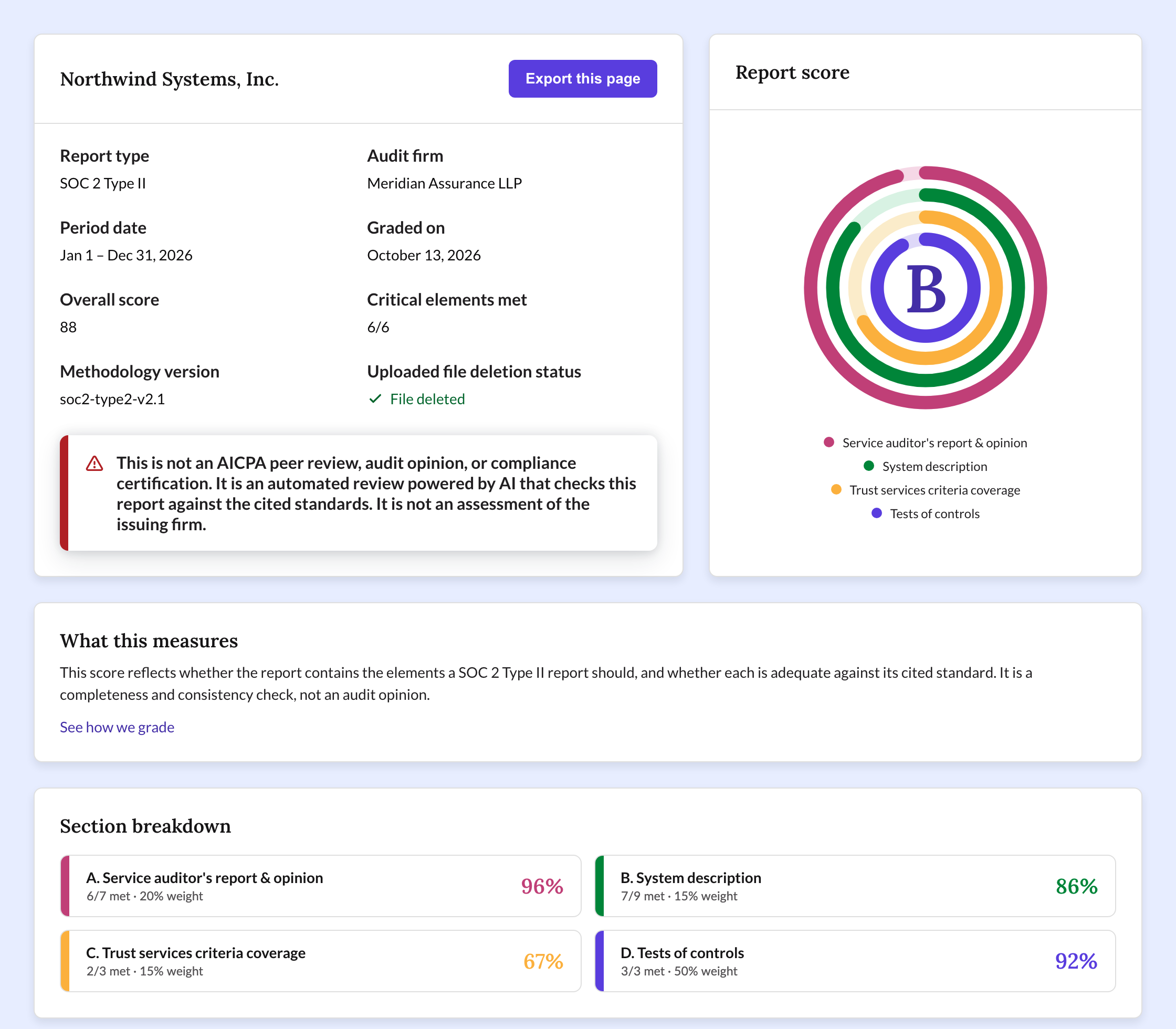

Why firms run their own reports
Peer-review-ready reports that hold up to anyone reading them.
Find a missing restricted-use alert, a thin system description or test results without specifics before a peer reviewer or a customer’s vendor-risk team reads the report.
Run reports from different engagement teams against the same 22 elements, so quality doesn’t depend on who was staffed.
Grade last year’s report and know where to focus before fieldwork starts.
What it checks
22 elements across four sections, each tied to an authoritative source. It checks whether the report contains what the standards require, not whether the underlying controls are effective. The grader checks against the standards. It doesn’t set them.
Opinion type, scope, management’s assertion, restricted-use alert and auditor identification.
The nine description criteria in DC 200, from services and commitments to subservice organizations and changes.
In-scope categories named, every applicable criterion mapped and tested, exclusions explained.
Procedures described with specifics, results stated, and each control traced to a criterion, test and result.
The critical gate
The grader’s methodology treats six elements as critical, each tied to AT-C 205, DC 200, TSP 100 or the SOC 2 Guide. If any one is missing or inadequate, the grade is capped at F regardless of the numeric score.
How it works
- 1Upload an issued report
A SOC 2 Type II report you’re authorized to share. PDF, up to 20 MB.
- 2AI classifies each element
A model running in our own cloud account reads the report at temperature zero, marks each of the 22 elements and quotes the supporting text.
- 3Code computes the grade
The score runs in code, never in the model, so every report is scored by the same math.
How we handle your report
An issued SOC 2 report is confidential. Here’s how the grader handles yours.
An AI model running in Audora’s own cloud account reads the report at temperature zero. It classifies and quotes; code computes the score.
Modern TLS in transit, and encryption at rest with automatically rotated keys.
Score summaries may be included in aggregated statistics that never identify you or your firm.
We don’t sell your report or your personal data. Contact details you provide follow our privacy policy.
Common questions
Is this a peer review?
No. It’s an automated completeness and consistency check against the cited standards. It isn’t an AICPA peer review, an audit opinion or a certification, and it isn’t an assessment of the issuing firm.
Read the methodologyWho sees my grade?
Only you. We don’t publish grades or scorecards, and we don’t compare or rank firms.
Grade a free reportWhat happens to my report?
An AI model in Audora’s own cloud account reads it, it’s encrypted in transit and at rest, and it’s used to produce your grade. Your score summary may be included in aggregated statistics that never identify you or your firm. For retention details, email security@goaudora.com.
Security and trust at AudoraWhy was my report capped at F?
One of six critical elements was missing or inadequate: the opinion type, the opinion’s subjects, the scope and period, management’s assertion, the in-scope categories or the test results. Without any one of them, a core requirement of the report is missing or unreliable.
See the critical gateWhich reports can I upload?
Issued SOC 2 Type II reports, as a PDF up to 20 MB, that you’re authorized to share. Type 1 reports, drafts and SOC 1 reports aren’t graded.
Grade a free report
The Audit Report Grader is not an AICPA peer review, audit opinion or compliance certification. It is an automated review powered by AI that checks a report against the cited standards. It is not an assessment of the issuing firm.